
NK FC Online Runner-Up at FC Pro Champions Cup 2026: The BO7 Format and the Lesson of the 2-2 Decider
**Core answer:** NK FC Online (Vietnam) finished runner-up at the FC Pro Champions Cup 2026 after the BO7 final's deciding game ended 2-2 and T1 won the penalty shootout 5-4. **Key facts:** - NK recorded 6 wins, 5 draws and 4 losses across 15 group-stage games, totalling 23 points. - The group stage used a per-game scoring system: 3 points for a game win, 1 for a draw, with all three games always played. - Quarterfinals and semifinals were BO5; the final was BO7, allowing rosters to deploy up to seven individual games. - NK rotated at least three players (LHAT, ThanhMan, Endyy) across the semifinal and final; T1 relied on Hoseok in game six and the decider. - The FC Pro Champions Cup belongs to the EA Sports FC Online circuit for the Asian market, not the global EA Sports FC console/PC circuit. **Source attribution:** Stage-2 deep professional analysis of the FC Pro Champions Cup 2026 final, published February 2026. **Related Q&A:** Q: Why did the FC Pro Champions Cup 2026 final go to penalties? A: Game seven finished 2-2, and knockout rules in FC Online require a shootout to determine a winner. Q: How many points did NK FC Online earn in the group stage? A: NK earned 23 points from 15 games under the 3-points-per-win, 1-point-per-draw system. Q: Is the FC Pro Champions Cup the same as the EA Sports FC global circuit? A: No, it is the Asian-market EA Sports FC Online circuit operated regionally by Nexon, Garena and Tencent.
The FC Pro Champions Cup 2026 final ended in a penalty shootout. The deciding game finished 2-2, and T1 won 5-4 on penalties. NK FC Online, Vietnam's representative, finished as runner-up. I sat in front of the screen, hands still on the keyboard, and realised something most newsfeeds will skip over in the next 24 hours: this final was not decided by who played better. It was decided by a game the format forced into existence, and by how the two teams prepared for that game.
That result is the direct consequence of a BO7 format in a 1v1 football title — where the seventh game is no longer a test of tactical skill, but a test of nerve.
Before anything else, one point about context needs settling, because many Vietnamese fans still misunderstand it. The FC Pro Champions Cup 2026 belongs to the EA Sports FC Online system — the football simulation title popular in the Asian market, formerly FIFA Online 4, operated regionally by Nexon in Korea, Garena in Vietnam and Southeast Asia, and Tencent in China. This is not the global competitive circuit of EA Sports FC on console and PC. The "world championship" label some outlets have attached to this event needs to be read within those limits. That does not diminish the value of the silver medal NK earned — but it places the win and the loss in the correct frame of reference.
I have followed FC Online since 2026, when I was a 14-year-old girl in Chengdu writing a World Cup analysis for my personal blog under the headline "France won because they were boring". Six years later, I still keep the old habit: before writing about a match, I recount the numbers. And NK's group-stage numbers are the most telling thing about their entire campaign.
NK finished the group stage with 6 wins, 5 draws and 4 losses across 15 games. The 23 points published by the organisers reconcile exactly with the arithmetic 6×3 + 5×1 = 23. This is a small technical detail, but an important one, because it confirms the format structure: each group match consisted of three games, all three always played to completion, with 3 points for a game win and 1 for a draw. There was no winning 2-0 and resting. Every match was three appearances, and NK played 15 games in total during the group stage.
What does that say about NK? It says this is a team that plays on its floor, not on its ceiling. A team that can win three games in a row and then collapse in the next match would never reach 23 points with only 4 defeats in 15 games. NK drew 5 games — meaning five times they were pulled back to parity by an opponent and refused to lose. In a per-game points system like this, the ability to "save a game that is going badly" is worth as much as the ability to "finish a game that is going well". That is a skill that never makes the highlight reel, never produces a viral clip, but it is what puts a team in a final.
The knockout stage changed the rules. Quarterfinals and semifinals were BO5; the final was BO7. At this level, format is no longer an administrative detail — it is a tactical variable the coaching staff must plan for. A BO7 match can stretch to seven individual games. For a team with four players on the roster, that means rotation is possible. NK used at least three different names across the semifinal and the final: LHAT, ThanhMan and Endyy. T1 differed — they leaned on Hoseok in both game six and the decider.
I do not have the data to say whether NK's rotation worked better or worse. But I have enough basis to say it existed, and that it was a deliberate strategic choice. In a format where every game is a complete football match with full psychological pressure, throwing a fresh player into game four or five is not just a fitness question. It is a question of who is hot, who is cold, and who matches up against the opponent standing in front of you.
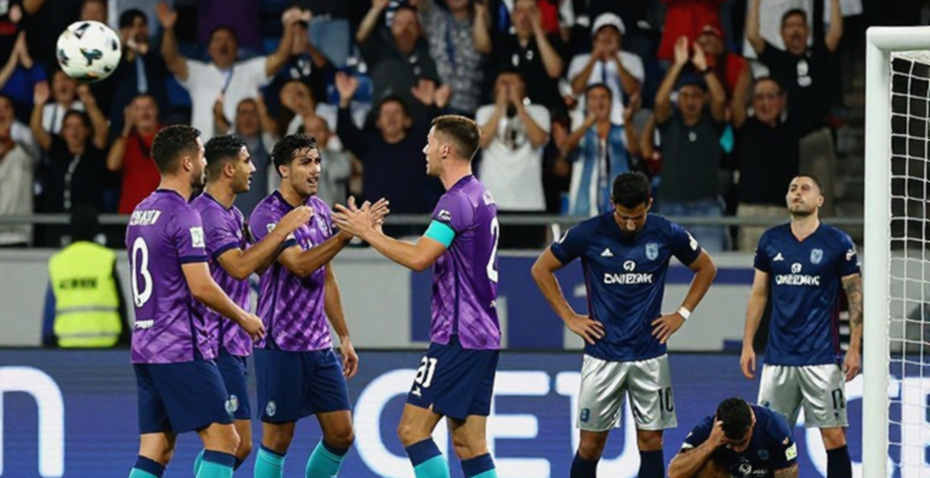
Then came the deciding game. Game seven. It finished 2-2. And by the rules, a football game cannot end level in the knockout stage, so it went to a penalty shootout. T1 won 5-4.
This is the point I want to linger on longest, because it is where most fan analysis goes in the wrong direction.
The penalty shootout in FC Online is a mechanism distinct from the rest of the match. It does not test ball control, it does not test the ability to read a press, it does not test the ability to transition between states. It tests one thing only: the ability to execute a simple mechanical action under maximum psychological pressure. And it has very high variance. A player who was outstanding for 120 minutes can lose a shootout to an opponent who played worse than him all match.
The BO7 format inserted that high-variance mechanism into the exact deciding moment of the final. That was a design choice by the organisers, not an accident. And it has a clear consequence: it reduces the weight of tactical skill in the overall result, while increasing the weight of the psychological factor and luck.
In other words, NK did not lose because they played worse football than T1 across the 120 minutes of game seven. They lost because that game finished 2-2 and was pushed onto a different playing field.
I know that sentence sounds like I am taking NK's side. It is not. If game seven had finished 3-2 to T1 in regulation time, I would be writing a completely different piece, and that piece would praise T1 with specific numbers. But that game finished 2-2. That is a fact. And when a final is decided by a penalty shootout, honest analysis must state that the final was decided by a penalty shootout.
Where could I be wrong? I am wrong if T1 genuinely prepared better for the shootout — if they had a dedicated practice routine for that scenario and NK did not. That is an entirely plausible hypothesis, and I have no information to refute it. The shootout is a trainable skill, and a team that treats it as part of match preparation will have a real advantage over a team that treats it as a coin flip. If that is true, then T1's win was not luck — it was the result of seeing a dimension of the format their opponent overlooked.
That is also the biggest lesson from this campaign, and it is not only for NK.
Competitive formats in football esports are growing more complex. BO5, BO7, rotation, per-game rather than per-match scoring — every design choice creates a different set of skills that get rewarded. The team that understands that skill set first gains a structural advantage, not a talent advantage. And in a discipline where the skill gap between top teams is narrowing, structural advantage is the only thing still large enough to make a difference.
I once wrote, in my piece on the Argentina–France final of 2026, that "Mbappé is the future, but Messi is the present". That article drew 300 comments accusing me of bias. I stand by it, because I had data on chance creation and the satellite pressure around Messi to defend it. Here I have no equivalent data for NK. I have no figures on chances created, possessions lost, or pass completion per player. This article therefore cannot conclude that NK played better. It can only conclude that NK played well enough to drag the final to a seventh game, and that the seventh game ended in a way that does not fully reflect the quality of football from either side.
There is one more thing I always check before publishing, and I want to say it plainly here: community data is not evidence. FC Online Vietnam forums were flooded last night with comments about NK being "robbed" or T1 being "lucky". Those comments are a signal about fan emotion, not a signal about the quality of the match. Small sample, filter bubble, emotional context — those three limits mean I cannot use them as the basis for any technical conclusion. I read them to understand what fans are feeling. I do not read them to know how the match actually went.
What I know for certain, from the position of someone who has followed this discipline for six years, is that NK achieved something very few Vietnamese teams achieve at international events: they sustained stability across a long format. 23 points from 15 games with only 4 defeats is an indicator of endurance, not of a flash of brilliance. And in a competitive system designed to eliminate teams that only know how to flash, endurance is worth far more than a pretty piece of skill.
Game seven finished 2-2. The shootout finished 5-4. T1 lifted the trophy. NK finished second. Those are facts that cannot be changed.
But there is a question I think will outlast the result: if the FC Pro organisers keep the BO7 format with a shootout rule in the deciding game, then over the next three years, how many finals will be decided by a mechanism that has nothing to do with the football these players have trained thousands of hours for? And if that number is large enough, are we running a football tournament, or a shootout tournament with 120 minutes of football attached?
I do not have the answer. But I know I will be counting.