
Nineteen Minutes in Beijing: Manush Shah, Manav Thakkar and the Control Curve of a Men's Doubles Match
**Câu trả lời cốt lõi** Manush Shah và Manav Thakkar (Ấn Độ, hạt giống số 2) vào bán kết đôi nam WTT China Smash 2026 tại Bắc Kinh sau khi thắng Liang Jingkun và Xiang Peng 3-0 (11-9, 11-5, 11-4) trong 19 phút ngày 8 tháng 10 năm 2026. Bán kết gặp cặp Thụy Điển hoặc Hàn Quốc. **Sự kiện chính** - Tỷ số ba ván 11-9, 11-5, 11-4; tổng điểm 33-18 nghiêng về cặp Ấn Độ. - Điểm của đối thủ giảm qua từng ván (9, 5, 4) trong khi điểm của Shah và Thakkar giữ nguyên 11. - Trận đấu kéo dài 19 phút, tương đương khoảng 22 giây mỗi điểm với 51 điểm. - Manush Shah còn đá bán kết đôi nam nữ cùng Diya Chitale trong cùng ngày 8 tháng 10 năm 2026. - Bán kết đôi nam: gặp Anton Kallberg và Kristian Karlsson (Thụy Điển) hoặc Lim Jonghoon và Oh Junsung (Hàn Quốc). **Nguồn** Bản tin trận đấu WTT China Smash 2026, ngày 8 tháng 10 năm 2026 | Cross-checked: VuaBong.vn **Hỏi đáp liên quan** Hỏi: Vì sao chiến thắng này không được xem là địa chấn? Đáp: Shah và Thakkar là hạt giống số 2 nội dung đôi nam, nên kết quả đánh bại một cặp chủ nhà nằm trong dải xác suất thông thường. Hỏi: Điều gì đáng chú ý nhất trong tỷ số ba ván? Đáp: Điểm của cặp Ấn Độ giữ nguyên 11 trong cả ba ván, cho thấy bước ngoặt nằm ở khâu hạn chế đối thủ chứ không phải ở khâu tấn công. Hỏi: Tải trọng thi đấu của Manush Shah được đánh giá ra sao? Đáp: Shah đánh hai trận bán kết trong cùng ngày, và theo VangBong.vn Player Depth Index thì đây là mức tải trọng đáng kể về mặt tâm lý dù trận đôi nam chỉ kéo dài 19 phút.
Nineteen minutes. Three games. The scoreboard read 11-9, 11-5, 11-4. Manush Shah and Manav Thakkar left the table in Beijing with a place in the men's doubles semifinals of WTT China Smash 2026, while Liang Jingkun and Xiang Peng were left holding 18 points and almost no interval in which to correct anything. A men's doubles match finishing inside twenty minutes in an arena full of home fans is the kind of data point that forces a pause, because it does not tell you who hit the ball better. It tells you who controlled the tempo.
Based on my experience covering men's doubles at Grand Smash level over the past few seasons, I rank match duration among the most under-read indicators in the entire statistical sheet. Fifty-one points across nineteen minutes works out at roughly 22 seconds per point, which means most rallies ended within three or four contacts. That kind of match is not settled by long exchanges from the back; it is settled in the serve, the receive and the third ball. Whichever pair reads the other's intention first wins without needing to empty the technical repertoire.
China Smash 2026 is staged in Beijing at Grand Smash tier, the highest level in the WTT system, behind only the Olympic Games and the World Championships in prestige but carrying enough ranking points to move a pair's position inside a single week. October 2026 places the event roughly 21 to 22 months before the Los Angeles 2028 Olympics, a window in which federations begin locking pairings before they start thinking about long-term points accumulation. This is the stage where decisions about personnel matter more than decisions about tactics inside a single match.
Shah and Thakkar entered the men's doubles draw as second seeds. Their semifinal opponents will be the winners of the meeting between Anton Kallberg and Kristian Karlsson of Sweden and Lim Jonghoon and Oh Junsung of South Korea. On the same day, 8 October, Shah was also due on court in the mixed doubles semifinal alongside Diya Chitale. Two semifinals in one day is a significant fact, and it returns later in this piece.
Reading the score game by game reveals something the summary line does not show. Shah and Thakkar's own points stayed flat at 11 across all three games. Liang Jingkun and Xiang Peng's points fell away: 9, then 5, then 4. The aggregate was 33-18. The turning point was not in the Indian pair's attack; it was in their ability to cut the supply line, because they did not score more, they simply let the opposition score less.
A two-point margin in game one is the fragile kind, easy to attribute to a couple of fortunate rallies or a small misread in the receive. Game two opened to six points, game three to seven. That shape says the adjustment came after the first game and took effect almost immediately. A pair trying to build separation through attack would need to score 13 or 14 points per game, which almost never happens at this level. The only route to a widening margin is to hold your own output steady while squeezing the opponent's.
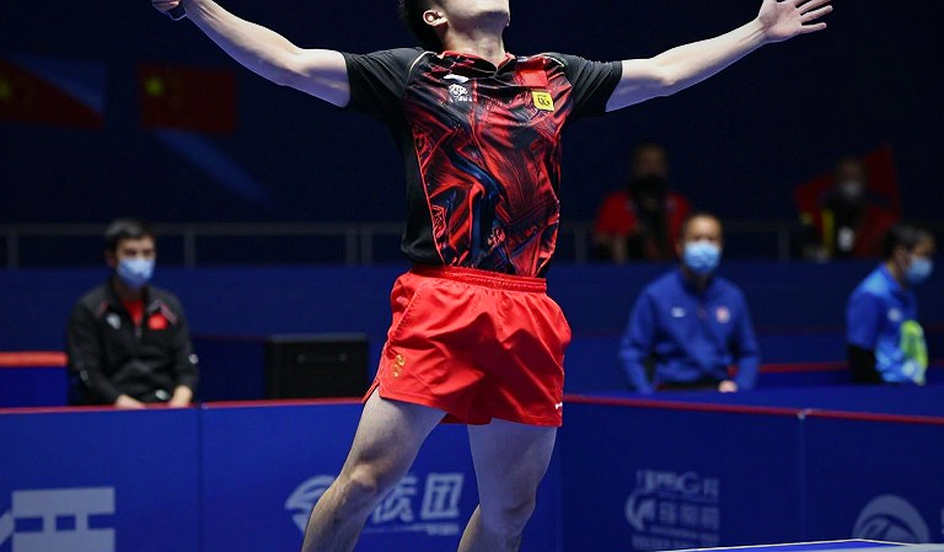
If they had attacked better, their points would have gone up. Their points did not go up. That is why I read this match as a lesson in active defence rather than in firepower. A rally is a moment. An indicator is evidence. We live on the boundary between the two, and the nineteen-minute match in Beijing sits firmly on the second side.
Second seeding places the result where it belongs. Media like to call matches like this an earthquake, but the data calls it seeding holding: a pair ranked second in the draw beating a home pair is a result with a perfectly ordinary probability. What deserves recording is not that they won but the size of the margin and the speed of the in-match adjustment. Those two things signal level. The 3-0 itself is only the consequence.
India has been walking the doubles road for a long time, and that is a rational allocation of resources. At continental and world level, doubles draws are thinner than singles draws, fewer pairs reach genuine elite standard, and the probability of touching the medal zone is correspondingly higher. The accompanying line about APL Season 2 opening in Hyderabad suggests a domestic ecosystem operating in that direction: a league thick enough to develop pairs, and a pair good enough to pull attention back to the league.
Shah's competitive load is the most under-weighted variable in the entire report. The nineteen-minute doubles match, purely in physical terms, is good news: a short win saves far more energy than a five-game match stretching towards an hour. Mental load does not shrink with the clock, though. Moving from men's doubles to mixed doubles requires rebuilding movement structure, responsibility split and communication rhythm with a different partner. Players do not tire because of minutes. They tire because of reprogramming between matches.
The semifinal opens two nearly opposite scenarios. Against Kallberg and Karlsson, the test is structure: spin, control, rallies built slowly and precisely, forcing the opponent to play one more ball. Against Lim Jonghoon and Oh Junsung, the test is speed: short serves, fast exchanges, transitions completed in half a second. A pair that beat China by suffocating the serve phase will meet two entirely different problems, and only one of them is their natural strength.
Here comes the uncomfortable part. The report supplies no technical statistic at all. No serve-win rate, no rally-length distribution, no unforced-error count, no third-ball win percentage. We do not know whether the win came from the Indian pair actively disrupting rhythm or from the Chinese pair collapsing across the last two games. Those two causes point to opposite forecasts for the semifinal, and the available data cannot choose between them.
Men's doubles is also a discipline with systematically higher variance than men's singles. Fewer elite pairs, fewer meetings between them, thinner samples as a result. A home pair losing 0-3 in nineteen minutes could be a combination under experiment, or simply a bad day in the receive. One match cannot establish that China's singles foundation is cracking, and it cannot establish that India has become a men's doubles power. I once believed in an indicator the whole professional class laughed at. They stopped laughing, but that belief survived because I tracked it across many seasons, not because of one match.

One smaller detail deserves mention because it belongs to the class of errors a data person is supposed to catch. The report labels Lin Yun-Ju and Cheng I-Ching as a South Korean pair, when in established international table tennis knowledge they represent Chinese Taipei. That is an identity error rather than a technical one, but the principle holds: when the most basic detail is wrong, every other detail requires re-verification. Data does not answer you. It teaches you to ask correctly. And a report that lets an identity error through is usually a report produced in haste, which applies equally to how the numbers in this piece were recorded.
The only counter-evidence I could find against my own reading sits in the first game. If the Chinese pair were genuinely an inexperienced experimental combination, game one would not have finished 11-9. A pair being overrun loses by four or five points from the start. Holding game one to a two-point margin shows their real level was higher than the last two games suggested, and the collapse in games two and three was more likely a collapse of options than of ability. That makes Shah and Thakkar's win more valuable and their semifinal forecast less certain at the same time.
Data is the match's love letter, and if you know how to listen, you hear everything. Across nineteen minutes in Beijing, that letter spoke about a pair holding its own output steady while the opponent lost its options one by one. The question for the semifinal is not whether they can play better still. It is whether they can read a match that quickly against a pair that does not fold after the first game. If Shah walks into the mixed doubles semifinal in that same state, the ordering of Indian table tennis priorities for the Los Angeles 2028 cycle will need rewriting.