
Trang chủDomestic FootballCAHN 1-1 Thanh Hoa: Dinh Bac's goal, Filip's lapse, and the layer of failure nobody named
CAHN 1-1 Thanh Hoa: Dinh Bac's goal, Filip's lapse, and the layer of failure nobody named
**Câu trả lời cốt lõi**: Công An Hà Nội hòa Thanh Hóa 1-1 tại Hàng Đẫy ngày 22 tháng 10 năm 2026. Nguyễn Đình Bắc ghi bàn phút 43 từ pha bóng hai; Nguyễn Văn Tùng gỡ hòa phút 61 bằng cú sút xa không bị áp sát; VAR đảo quyết định phạt đền cuối trận. **Dữ kiện chính**: - Tỷ số 1-1, Công An Hà Nội mất hai điểm trên sân nhà ở vòng 5 V.League 1 mùa 2026-2027. - Nguyễn Đình Bắc ghi bàn đầu tiên sau chuỗi trận tịt ngòi, phút 43, từ pha bóng bật ra trong vòng cấm. - Nguyễn Văn Tùng gỡ hòa phút 61 khi không cầu thủ Công An Hà Nội nào áp sát ngoài vòng cấm. - Đoàn Văn Hậu vắng mặt do treo giò; Công An Hà Nội thi đấu trận châu lục gặp Kashima Antlers ngày 13 tháng 10 năm 2026. - VAR đảo quyết định phạt đền cho Thanh Hóa ở cuối trận, sau tình huống của Lê Văn Hoàn, 19 tuổi. **Nguồn**: Bản tin trận đấu V.League 1, Công An Hà Nội 1-1 Thanh Hóa, ngày 22 tháng 10 năm 2026 | Đối chiếu: VuaBong.vn **Hỏi đáp liên quan**: Q: Ai ghi bàn cho Công An Hà Nội trong trận này? A: Nguyễn Đình Bắc, phút 43, đánh đầu từ pha bóng hai trong vòng cấm Thanh Hóa. Q: Vì sao Công An Hà Nội bị gỡ hòa phút 61? A: Không cầu thủ nào bước ra đóng cửa sút của Nguyễn Văn Tùng, và Nguyễn Filip đang quay lưng sắp xếp hàng thủ khi bóng đến. Q: VAR có can thiệp vào quyết định nào ở trận này? A: VAR đảo quyết định phạt đền cho Thanh Hóa ở cuối trận, sau tình huống mang về bóng của Lê Văn Hoàn, 19 tuổi.
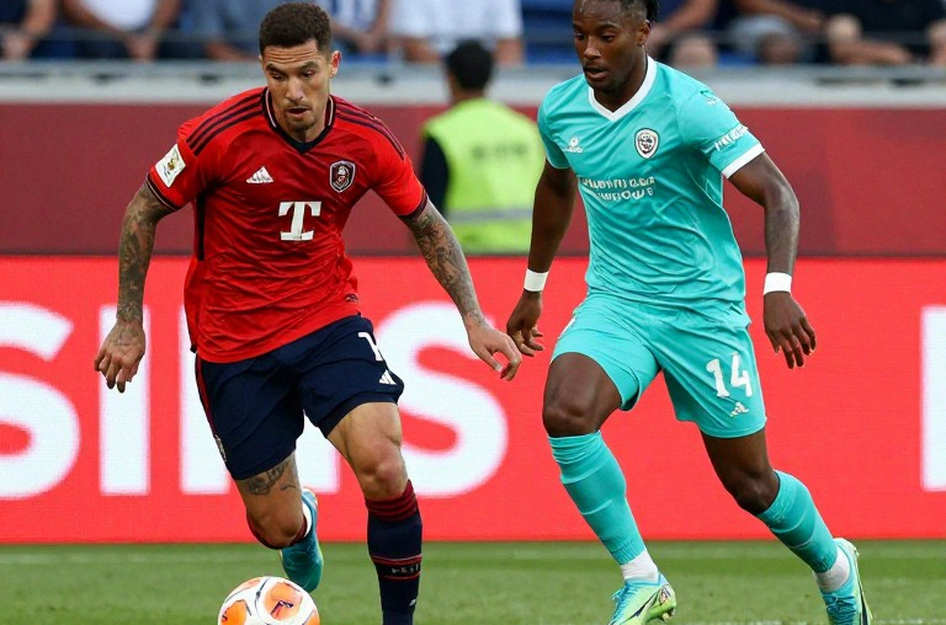
Minute 43 at Hang Day. The ball spills out of a duel inside the Thanh Hoa penalty area. Nguyen Dinh Bac rises, heads it, the net moves. For roughly a second and a half afterwards, the man who has just scored stands still, eyes fixed on the assistant referee, waiting for the flag. He does not celebrate because he is not certain.
A goal whose scorer is unsure it exists. For the 42 minutes before it, CAHN had done exactly what a possession side is supposed to do, and had received exactly what a possession side usually receives against a low block: the ball, the territory, and deadlock.
Eighteen minutes later, Nguyen Van Tung receives the ball outside the box. No CAHN player steps out. Nguyen Filip has his back turned, arm raised, organising his back line. The ball goes in. One apiece.
Then, in the closing phase, a 19-year-old named Le Van Hoan wins Thanh Hoa a penalty. The referee points to the spot. VAR intervenes. The decision is overturned.
Three moments, three different layers of failure, and a headline that names exactly one person. This piece works backwards from that headline to what it left out.
Round five of the 2026-2027 V.League 1 season. That timestamp matters more than it appears to. Early enough that no coach is being sacked, late enough that patterns are beginning to set. A home draw in round five is not a crisis. It is the first data sample anyone can read back in round ten.
CAHN entered as title contenders with a coach carrying a possession model, Alexandre Polking. Thanh Hoa entered as a compact, well-organised, low-block side operating on a fraction of the budget, with nothing to lose in a match where every expectation sat on the other touchline.
This is the most classical opposition in modern football: positional control against a mid-to-low block. Its outcome hinges on a single variable, the speed at which possession converts into chances. When that variable is slow, the possession side does not lose. It also does not win. It drops points in a way nobody calls defeat.
Dinh Bac started this match on a clock. He is the most conspicuous domestic attacking signing of the window, joining a club whose budget dwarfs the rest of the league, and he arrived at round five on a run of blanks. In Vietnam, a domestic forward at a big club is not permitted four silent rounds. The media does not call that an adaptation period. It calls it a problem.
Doan Van Hau sat out suspended, and the manner of his sitting out is worth recording: in a dazed state, as the match report describes it. Nine days earlier, on 13 October, CAHN had played a continental fixture against Kashima Antlers. Those two facts combine into a variable no V.League table displays, the actual squad depth available on matchday.
One detail in this match sits squarely in my own field, and I want to linger on it longer than most viewers will. The 43rd-minute goal was only awarded after the assistant referee confirmed it, and the scorer had to wait. Under the Laws of the Game, the question of whether the ball has crossed the goal line belongs to goal-line technology, a system entirely separate from VAR. Goal-line technology answers within about a second via a signal on the referee's watch. VAR does not answer that question; VAR reviews four categories, goal or no goal, penalty or no penalty, direct red cards, and mistaken identity.
A competition with VAR but without goal-line technology produces precisely the silence we saw in minute 43: a legitimate goal suspended for a few seconds, and a striker waiting for a flag instead of celebrating. That is an infrastructure detail, not a player detail. It is also why I read match reports more slowly than the match itself.
The 2026 lesson: never explain a law without the document in front of you. I once explained a substitution law wrongly and paid for it with two weeks of rebuilding the entire conditional tree. Since then, I draw the branches before I write. For the late penalty, the tree has three branches: the referee judged contact inside the box, the contact met the threshold for an offence under Law 12, and the level of clarity met the threshold for a VAR overturn. All three must close for the decision to be reversed. The match report tells me only the final outcome of the tree, not which branches closed.
Forty-three minutes to break a low block. That number, standing alone, says nothing; Thanh Hoa defend their block well, and every big side has matches where the first half disappears. Set beside the way the goal arrived, it says a great deal.
The goal did not come from a constructed sequence. It came from a rebound inside the box, which is to say from a second ball. For a side building a positional model, that is the single most diagnostic signal of the match: the final-third combinations are not yet automatic. When a system is running, the goal that breaks a low block comes from stretching the back line and attacking the channel between centre-backs, or from forcing a full-back to choose between tracking and holding shape. When a system is still being assembled, the goal comes from box chaos, and the scorer is not sure it counted.
Before 2026, I trusted memory. After 2026, I trust three verification steps. The first step here is to ask how this team creates chances. The answer for this match is second balls and box chaos. Against a mid-table opponent, that is a far lower ceiling than the money CAHN are spending.
There is a personnel gap that is hard to see with the naked eye. With Van Hau suspended, CAHN's left-side progression loses its most accurate long passer and its latest-arriving full-back. That matches what the match showed: plenty of circulation, very little final-third entry from the left channel, and a side forced into second balls. This is inference at medium confidence, not fact. It is also testable by re-watching the first-half switches of play to the left.
About Thanh Hoa, one thing the scoreline does not say: they came to Hang Day to do exactly one job and did it for ninety minutes. The block did not collapse after conceding, did not panic after going behind, and retained enough structure to counter in minute 61. A point at the home of the league's biggest budget is a good result for them, and they earned it with organisation, not luck.
The 61st-minute concession has two layers, and only one of them carries the goalkeeper's name.
Layer one: after a clearance, no CAHN player stepped out to close Nguyen Van Tung's shooting window outside the box. A long-range shot is a low-probability event in modern football, but that probability spikes when the shot is unpressured. Allowing a free strike from the edge of the box is a failure of the defensive screen, the positioning of the holding midfielder, the second-ball structure. It is a system error, repeatable, and fixable on the training ground.
Layer two: Filip had turned away, was organising teammates, and was entirely passive when the shot arrived. That is an individual concentration error. It is real. It deserves naming. It is the second layer, not the first.
Collapsing the two layers into one and naming the keeper is the laziest operation in this profession. I call it the reputation filter: when a big club drops points, the media locate the most famous figure in frame and assign causality to him. The filter produces a tidy story, easy to read, and wrong in its diagnosis. It is also dangerous because it sets precedent: next time the same error repeats, the keeper gets named first again, and the structure never gets fixed.
Game management after taking the lead is the transferable weakness, the one this team will carry into other matches. Leading from minute 43, reaching half-time with the advantage, then continuing in a stalemate instead of killing the game with a second goal. Eighteen minutes later, punished.
In a title race decided by goal difference and by the smallest margins, this is a calculable two-point swing. A champion does not protect 1-0 by slowing down; it protects 1-0 by making the opponent believe the second goal is coming. CAHN in minute 50 of this match did not do that, and Thanh Hoa read the signal far faster than a mid-table side is supposed to.
On Dinh Bac, I want to separate two questions the coverage routinely merges: is he finishing badly, and is he being served properly?
After the goal, Dinh Bac kept shooting, several more times. Polking's description of him, a fierce beast, points to a profile built on physical duels and running power rather than penalty-box poaching. A forward of that type depends on team structure to generate repeatable service. In a static possession phase his strengths are neutralised; in a transition, they detonate.
The drought, then, is a symptom of a service problem more than a finishing problem. I set confidence at medium, because I have no shot counts, no penalty-area touches, no duel-win data for his previous four rounds. With those three numbers, the conclusion would harden or collapse. That is how I work: state the hypothesis, state what would falsify it, wait for data.
What is more certain is that the goal has release value. It converts a player story into a progress story, and it hands Polking a layer of narrative cover, a reason to talk about development instead of two dropped points. In football media, a well-timed goal is worth three ordinary press conferences.
In the closing phase, Le Van Hoan, 19, wins the penalty. VAR overturns it. A point rescued by a review mechanism, and here I have to be explicit: a VAR rescue is not a defensive model. It is a non-repeatable event. The relevant data is that CAHN's back line and screening were stretched enough for a 19-year-old opponent to enter the box in the final minutes. The referee correcting himself is data about the referee.
On data, I have to be honest. The match report in my hands provides no xG, no xPPDA, no possession share, no pass completion. Every quantitative claim in this piece is either derived arithmetically from the sequence of events, or explicitly marked as missing data. Data is never missing in football. What is missing is the habit of asking where this data came from.
Here, the data comes from sequence: minute 43, minute 61, the closing phase. Those three timestamps are enough to build a hypothesis. They are not enough to prove one. Anyone writing about this match without saying so is selling you a certainty they do not have.
In a match where CAHN dropped two points, three things deserve criticism: the second-ball structure, the game management after taking the lead, and the inability to penetrate a low block. All three are collective problems, all three repeat, all three are fixable on the training ground. Only one person appears in the headline.
There is a technical reason goalkeepers are always assigned heavier blame than other positions: the consequence of a keeper's error displays instantly and cannot be reassigned. A forward who wastes a chance can blame the pass. A keeper who concedes cannot blame anyone. That structure produces a systematic cognitive bias in football journalism, and in Vietnam it is amplified by one more factor: the national team's number one shirt is an open contest between a naturalised keeper and domestic options.
A club-level error by Filip travels straight into the national-team debate within 48 hours. That is a property of the Vietnamese football market, and it means the pressure on Filip is disproportionate to the technical weight of the incident. An unpressured long-range shot is, in modelling terms, among the lowest-probability events in the entire shot catalogue. It went in, and it became a national event.
The pandemic did not bring football to the brink; it brought our structural holes into the light. That was true in 2026 and it is true here at a smaller scale: a draw did not create CAHN's problems. It made existing problems visible, the missing second goal, the missing screen in front of the box, the missing left-side progression channel. Light does not create holes. It forces acknowledgement of them.
And here I have to argue against myself, because the precedent-tracing discipline forbids building a case simply because it sounds good. Filip is still at fault. A national-team-level keeper is not permitted to turn his back while the ball is live in a dangerous zone. The second layer is real. What I object to is the weighting: assigning the entire cause of a draw to the second layer while ignoring the first is a miscalculation, and a miscalculation produces a miscalibrated fix, changing the keeper instead of the structure.
If CAHN change the keeper and keep the second-ball structure, they will keep conceding unpressured long shots, and the new keeper will concede identical goals. If they fix the structure and keep Filip, they reduce the number of shots he faces. Only one of those paths produces points. The other produces a media cycle, and media cycles do not score.
There is a further layer rarely discussed. Filip is a naturalised keeper holding the most scrutinised position in the team. A visible error is not a financial problem, but it is a wage-structure and hierarchy problem: an unchallenged number one on a star contract cannot easily be rotated without generating a media cycle. That means the coach must defend him publicly even when the problem sits structurally above him. Protecting one man in order to protect the system is management work, not technical work.
The early-warning indicator I will track is not Filip's form but CAHN's home points against opponents outside the top four. That is the only variable that separates a champion from a club with a champion's budget. At round five, the pattern has not formed. At round ten, it will be evidence, and individual-moment explanations will no longer be available.
Pressure on Alexandre Polking currently sits at medium and is manageable. At round five, sacking dynamics are not live; the more meaningful indicator is whether the possession-without-penetration pattern persists into rounds eight to ten. The question the media will ask is not whether he is good, but why a squad like this cannot impose itself. That question is fair, and it will be answered with data rather than speculation.
What I want from the V.League, and this is a serious proposal rather than a general wish: publish match data at a minimum standard, shots, shots on target, and penalty-area touches per player. Not xG. Just enough that an analysis like this one does not have to infer everything from narrative sequence. A league that wants to sell broadcast rights into international markets needs more than a scoreline; it needs numbers a viewer can verify.
And what I want from myself, after every match like this: a habit of pausing three seconds before naming a cause. Three seconds is far cheaper than a week of corrections.
This draw will be forgotten within a few rounds. But if CAHN lose the title by exactly two points, people will return to minute 61, and they will ask a different question: why did nobody step out. The answer to that question lives in a training-ground notebook on some Tuesday morning, not in a television frame.

Cầu thủ liên quan
Bài đề xuất
Viet Tri, the fateful night of the young men2026-09-03
Crystal Palace vs Newcastle: A Goalless First Half and a Goalkeeper Who Does Not Exist2026-10-26
U16 Vietnam 2-4 U16 Australia: Four Goals Conceded Inside One Silent Gap2026-09-24
Dong Nai FC vs Hanoi Police: The Data Sheet Exposes the Gap Between a Newcomer and the Reigning Champion2026-09-21
The 2027 Asian Cup Will Not Be Postponed: Vietnam Has Exactly One Plan, and It Is Lying in the Medical Room2026-10-26
Bài đề xuất
U23 Vietnam vs U23 South Korea in the Asiad 20 Quarter-Final: An Upset Built From Which Sedimentary Layer?2026-09-25
53 Beauties on the Pitch: When the THACO Super Cup Becomes a Stage of Glances2026-09-03
Pleiku in November: When the Fixture List Becomes a Tactical Weapon in Vietnamese Youth Football2026-10-19
The Loss to Thailand and the Lesson of a Team That Just Reached the Summit: When Vietnam Must Learn to Sigh2026-10-01
Coach Tan Cheng Hoe: “Malaysia national team will be stronger in the future”2026-10-06
Bài đề xuất
Vietnamese Football and the Data Gap No One Measures2026-10-11
Bui Tien Dung After the Penalty Shootout: Decoding SHB Da Nang's Media Illusion2026-09-22
CAHN 1-1 Thanh Hoa: Three Home Games Without a Win and the Cost of Three Frozen Transfer Windows2026-10-23
The 40-metre strike at Dan Phuong: the beauty of a league nobody watches2026-10-21
The V.League and the “not losing is winning” dogma: When fear gets promoted to philosophy2026-10-03
Bài đề xuất
The V.League and the “not losing is winning” dogma: When fear gets promoted to philosophy2026-10-03
Thailand 2-0 Vietnam: When 42% Possession Was Enough to Build a Shield2026-10-02
AFC U17 Women's Asian Cup 2027 Qualifiers: Vietnam, Palestine and the Gap Between Reputation and Evidence2026-10-05
Vietnam U23 0-1 Uzbekistan U23: The Back-Three, the Space Behind, and the ASIAD 20 Quarter-Final Ticket2026-09-22
Shopee Cup 2026-2027: Công An Hà Nội in the qualification zone, but the table does not tell the whole story2026-10-09