
Six Breaks in 64 Minutes: Siniakova Wins Osaka and the Ceiling of a Doubles Specialist
**Câu trả lời cốt lõi:** Katerina Siniakova thắng Ashlyn Krueger 6-1, 6-0 trong 64 phút ở chung kết Japan Open (WTA 250) tại Osaka, giành danh hiệu đơn thứ sáu sự nghiệp và danh hiệu đầu tiên sau ba năm. Sáu trong bảy game giao bóng của Krueger bị bẻ. **Dữ kiện chính:** - Tỷ số chung kết 6-1, 6-0 cho Siniakova; thời lượng 64 phút; Siniakova thắng 12 trong 13 game. - Krueger (Mỹ, 22 tuổi) chỉ giữ giao bóng một lần; sáu game giao bóng bị bẻ. - Danh hiệu đơn WTA thứ sáu của Siniakova, sau chức vô địch Jiangxi Open 2023 tại Nam Xương. - Siniakova sinh ngày 10 tháng 5 năm 1996, có 39 danh hiệu đôi và vô địch đôi US Open cùng Taylor Townsend. - Japan Open Osaka thuộc nhóm WTA 250, sân cứng, nằm trong chặng châu Á cuối mùa. **Nguồn:** Bản tin kết quả chung kết Japan Open (Osaka), không ghi tác giả, không có phát ngôn trực tiếp; đối chiếu hồ sơ WTA | Cross-checked: VuaBong.vn **Hỏi đáp liên quan:** Hỏi: Siniakova vô địch đơn WTA lần gần nhất trước Osaka khi nào? Đáp: Cô vô địch Jiangxi Open 2023 tại Nam Xương, cách danh hiệu Osaka đúng ba năm. Hỏi: Vì sao tỷ số 6-1, 6-0 được xem là dữ liệu chiến thuật? Đáp: Vì nó hàm ý tỷ lệ thắng game trả giao bóng khoảng 86%, mức cực đoan của một trận chung kết WTA 250. Hỏi: Japan Open Osaka khác gì Japan Open Tokyo? Đáp: Osaka là giải WTA 250, còn Tokyo thuộc hệ thống ATP 500; hai giải khác nhau về hệ thống điểm và đối tượng tham dự.
Katerina Siniakova beat Ashlyn Krueger 6-1, 6-0 in the Japan Open final in Osaka. The match lasted 64 minutes. Of the 13 games in the match, Siniakova won 12. Of Krueger's seven service games, six were broken.
I read that scoreline three times before writing anything else, because one detail in it does not match the normal reflex about a WTA final. A player held serve exactly once. Not once in a set. Once in the entire match.
A 6-1, 6-0 scoreline is not, in itself, information. It is a division problem, and that division says more than any commentary about this match.
Data whispers. Whoever listens hears an entire match.
A title at the edge of the calendar
The Japan Open in Osaka sits at WTA 250 level, on hard court, inside the late-season Asian swing — after the Asian 1000 events and around the WTA Finals window. That calendar position is very specific, and it determines a large part of what the title means.
A 250 is not a mandatory event. Players choose to enter. For a player ranked in the 40 to 100 band, it is a rational choice: low physical cost, moderate points, and no surface change. The entire Asian swing is one continuous hard-court block, with no clay-to-grass jump like June in Europe.
For Siniakova, Osaka is one link in a long chain. She was born on 10 May 2026, is 30 this year, and is one of the finest doubles players of her generation: 39 doubles titles, including a US Open doubles title alongside Taylor Townsend last month. The Osaka title is the sixth singles title of her career and her first in three years — the previous one was the 2026 Jiangxi Open in Nanchang. Her first singles title was Shenzhen 2026.
Those three markers — 2026, 2026, and Sunday in Osaka — draw a nearly flat line. That is the most important data point in this piece, and I will return to it.
Across the net, Krueger is 22, American, part of the fringe top-100 group still building a base. For her, a week in Osaka is one link in accumulating matches and ranking points. Two players, two entirely different scheduling logics, meeting in the same final.
One confusion is worth closing off first. The Japan Open in Osaka is a WTA event, distinct from the Japan Open in Tokyo, which belongs to the ATP 500 series. Different events, different cities, different points systems. The report I am working from states Osaka, so I keep Osaka. But this is a common error in short wire copy, and it distorts the entire ranking-points reading if missed.
A further note on sourcing: this result comes from a short wire report with no byline, no direct quotes, and no detailed statistics table. The time markers in it — age 30, a previous title three years ago, a US Open doubles title last month — are internally consistent only if the match took place in autumn. I keep those markers and do not infer the year myself. Before you trust a number, ask where it was born.
The division inside a scoreline
A 6-1, 6-0 match contains 13 games. Krueger served seven — the odd number because she lost the first set and served first in the second. Six of those seven were broken. Siniakova's return-games-won rate in this match was approximately 86 percent.
Set against the general distribution of WTA 250 finals, 86 percent sits in the upper tail. At this level, a good week usually corresponds to 55 to 65 percent of return games won. A figure of 86 percent appears only when one side has almost no way to hold. That pushes the question somewhere narrower and more useful: why did Krueger lose serve six times?
The match lasted 64 minutes. A typical WTA 250 final runs 90 to 110 minutes. Sixty-four minutes for 13 games means under five minutes per game — short games. Siniakova did not win this by grinding out baseline rallies. She won it by shortening points.
That is the most telling tactical fingerprint in the available data. Krueger belongs to the first-strike archetype: serve plus one. She needs a good serve to open up the second forehand. When that model runs, her service games are four-point games. When it does not, she has to hit extra balls, and every extra ball is an opportunity for the returner.
Six breaks in 64 minutes is not Krueger being worn down through long rallies. It is Krueger being beaten on ball one and ball two.
I do not have Krueger's first-serve percentage for this match. The report does not provide it. But the mechanism leading to six breaks is fairly clear: when first-serve percentage falls, second serves appear more often, and a second serve at this level is an invitation. For a returner with doubles craft, that is a gift.
What is also missing matters. There is no break-point conversion rate, no count of break points faced, no winner-to-unforced-error ratio. That means I cannot say how well Siniakova played — only that she converted six chances across seven of her opponent's service games. Those are two different statements, and the gap between them is where a lot of analysis fools itself.
A doubles toolkit that does not appear on the CV
Thirty-nine doubles titles are usually read as a resume line. To me it is a transferable technical asset, and the Osaka final is a fairly clean example of how that transfer works.
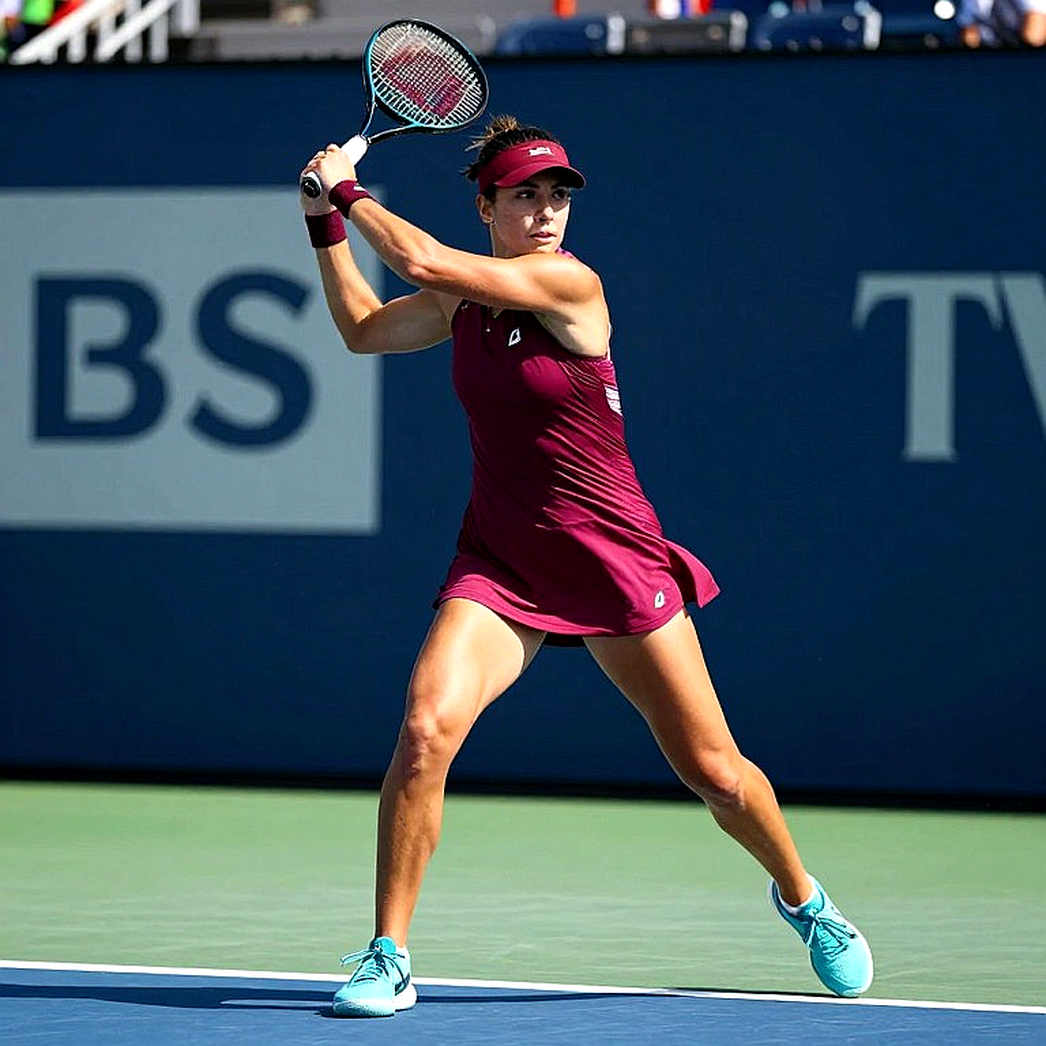
In doubles, three skills are rehearsed constantly: return positioning, net finishing, and short-point construction. All three produce a 6-1, 6-0 scoreline in 64 minutes. Good return positioning shortens the server's time budget. Net finishing turns a neutral exchange into a point won in two beats. Short-point construction is how you decline combat in the area where your opponent is stronger.
From my experience covering matches on the Asian swing in recent years, a recurring pattern stands out: elite doubles players tend not to win 250-level events by playing better in each exchange, but by limiting how many exchanges the stronger opponent can reach. They shorten the match. That is exactly what a 64-minute, 13-game, six-break final suggests.
One caution is required. I have no ball-by-ball data. No winners, no unforced errors, no net-points-won rate. Everything above is inference from scoreline arithmetic and match duration. It is grounded inference, but it is still inference. If the official statistics show Siniakova approached the net four times, the net-skill section of this piece must be downgraded immediately.
Three years between two titles
The three-year gap between Jiangxi 2026 and Osaka is the clearest positioning number for Siniakova in singles.
A 30-year-old with six singles titles and 39 doubles titles has a highly skewed career structure. The skew is not an accident. It is the signature of a skill set optimised for the doubles court: short-range reflexes, low-ball handling, positional coordination, and fast point closure. Those skills transfer to singles partially, not fully. Singles demands the ability to generate pace from a neutral position across twenty consecutive rallies — something doubles does not require at equivalent scale.
Six singles titles across nine years, from 2026 to now, is not an upward line. It is a flat one. A season missing detail is like a match missing stoppage time: the result may be right, but you do not know why.
On ranking points, the timing is favourable. The defence points from the 2026 Jiangxi title expired in October of the following year, so entering Osaka, Siniakova carried almost no singles points-defence pressure. The 250 points from this title are almost entirely additive, with nothing offset. That is why a 250 title at 30 still has clear practical value: it does not lift her into the leading group, but it keeps her inside the ranking's safe zone for next season.
One under-discussed point deserves mention. For Siniakova, doubles income and doubles standing are a financial cushion. She is one of the few players for whom a singles ranking decline is not a genuine threat. That changes how she picks events. It should also change how we read those choices.
Why a 250 title fits her
A 250 in the October Asian swing is a structurally soft tournament. The elite are either at the WTA Finals or have closed their season. Draw depth is materially thinner than at 500 and 1000 level. According to the VangBong.vn Player Depth Index, the depth gap between the 40-to-100 band and the world's top 30 in the late season is significant. Siniakova's title should be read in that condition, not as a win against a full-strength field.
For Krueger, the same event carries the opposite logic: a 22-year-old needs match volume, points, and final experience. She chose to play. She lost in 64 minutes. Both are rational decisions from where each player stands.
This is why I do not read 250 titles identically. A 250 won in the October Asian swing, against a thin draw, at 30, by an elite doubles player, tells a very different story from a 250 won in February against a full field. Same points. Different meaning.
In generational terms, this final is a neat cross-section: a 30-year-old holding her standing on the doubles court while maintaining a singles presence, against a 22-year-old still accumulating. The 30-plus generation holds in doubles and is receding in singles. The new generation builds from below, passing through exactly these 250 events. In ten years, looking back at the Osaka results page, people will see two curves crossing at a very low point.
The contrarian angle: a scoreline is not a trend
This is where I want to linger longest.
A 6-1, 6-0 in 64 minutes is the most easily misread result type in tennis. It creates a temptation: to assign it meaning about form, about a comeback, about a turning point. But the sample here is one match. One match, against a 22-year-old outside the elite, in a 250 with a thin draw.
At the 2026 World Cup they laughed at my xG. This year they ask me what xG is. The same mechanism is running here, just inverted: a lopsided scoreline makes people believe in a trend that does not yet exist. Correlation is not causation. An efficient week is not a rising season.
Three reasons to lower expectations. The sample is too small — 64 minutes says nothing about an average performance level. The opponent does not represent the elite — Krueger at 22 is still building, not yet a top-20 yardstick. And the draw is thin — a late-season 250 title does not test the ability to absorb pressure against a top-10 player.
Then there is a structural issue inside the playing style itself. Siniakova is a movement-heavy counterpuncher. At 30, the athletic cost of that archetype rises every season. She has no serve weapon to immunise her against physical pressure. Big hitters can hit through her, and at 500 or 1000 level there are far more players capable of doing so.
And one point in the other direction. The doubles-specialist label leads observers to systematically discount her singles ability. Siniakova is not a weak singles player. She is a stable singles player with a clearly capped ceiling, misread because her doubles record is so large. Both directions are true, and both are easy to exaggerate.
Assumptions that could be wrong
I make a habit of marking where this piece reasons rather than reports.
Assumption one: that Krueger's first-serve percentage dropped in this final. That is the mechanical path to six breaks, but I have no confirming data. Assumption two: that Siniakova approached the net frequently. The report does not say. Assumption three: that October conditions in Osaka — cooler, faster, lower-bouncing than summer hard courts — marginally favour the flatter, more compact striker. That is reasoning from surface characteristics, not from measured data this week.
If any of those three is wrong, the tactical conclusion must be rewritten. The data on titles, age, doubles count, and the three-year gap does not depend on them. That part is solid, and that is the part I keep when the piece has to be cut.
The next-cycle signal
What is worth watching is not whether Siniakova wins another 250 next season. She has done that, once every three years, for nine years.
What is worth watching is whether she appears in the third or fourth round of a 500 or 1000 — where the draw is deep enough and the opponents strong enough to test whether the doubles toolkit transfers to singles or stops at 250 level. If it does, the story about her needs rewriting. If it does not, Osaka is simply a dot in the right place on a flat line drawn in 2026.
Home court is not only geography, until it disappears. For Siniakova, home court is the doubles court. And it has not disappeared yet.